
.svg)




Imperial Vienna French Balcony Suite: The Trail Shot That Moves from Palace Interior to the Ringstrasse Without a Cut
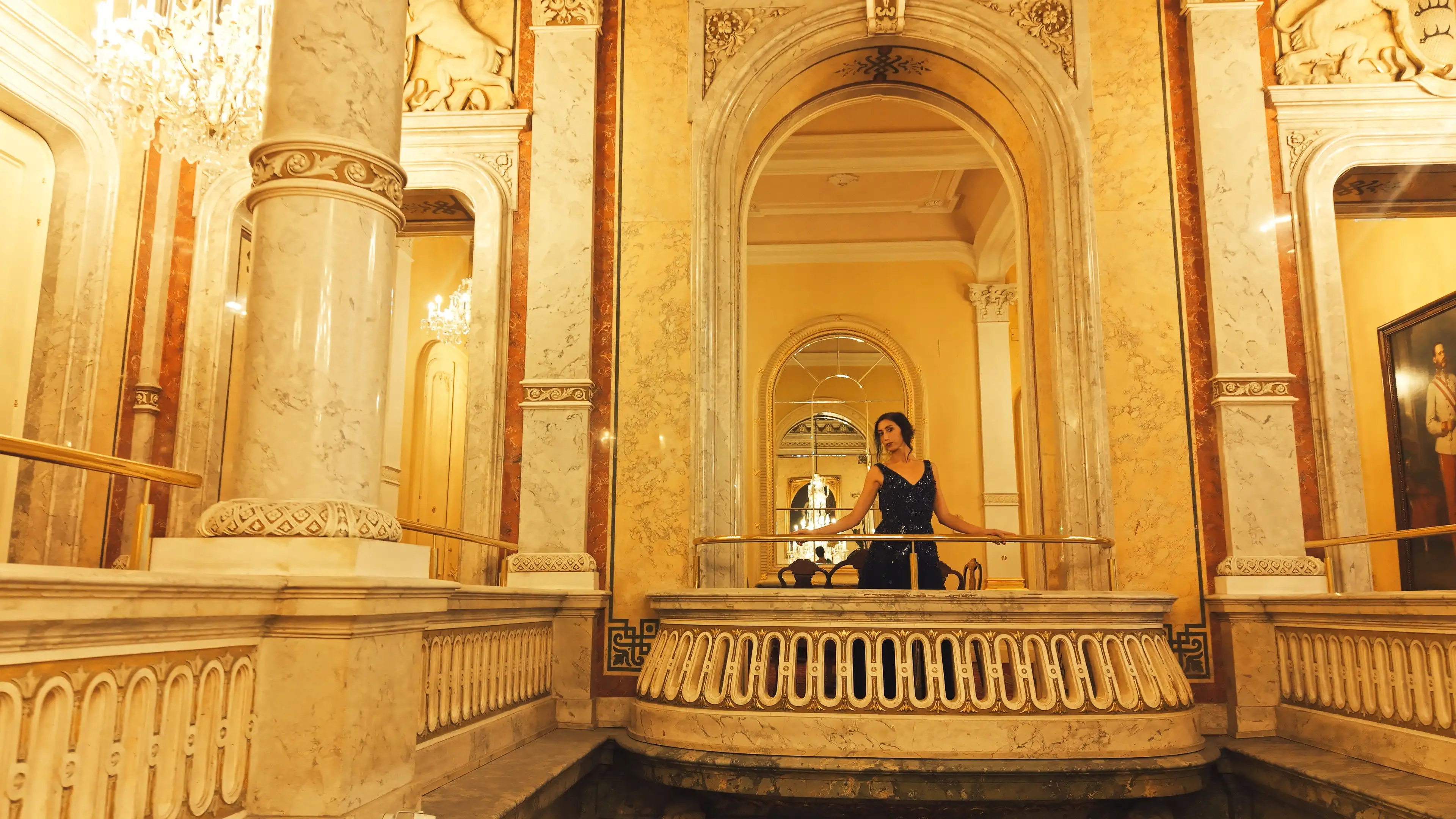

Quick answer: The French balcony suite on the fifth floor of the Imperial Vienna has one defining characteristic that no other room in the building shares: a balcony opening that faces the Ringstrasse directly, at sufficient width to allow a sub-250g drone to pass from inside the suite to the boulevard below in a single unbroken movement. Cover Page produced this shot. It exists as a continuous aerial with no cut.
What Makes the French Balcony Suite Different from Every Other Room at the Imperial?
The Imperial Vienna has 138 rooms across multiple floor configurations. Most face the interior courtyard or secondary streets. The fifth-floor French balcony suite faces the Ringstrasse, Vienna's ceremonial boulevard, commissioned by Emperor Franz Joseph I in 1857 and completed across the following decades. From the balcony, the Staatsoper is visible to the left. The Kunsthistorisches Museum occupies the far end of the visual axis.
The balcony itself is a French design: floor-to-ceiling doors that open onto a narrow railing with no platform floor, so the interior and the street are separated by glass and a threshold rather than by a proper terrace. This means the opening from inside to outside is unobstructed by balcony furniture, planters, or structural framing. The clearance from the open door frame to the railing is approximately 40cm on each side of the drone's flight path.
That 40cm figure is what makes the trail shot possible. Without it, the sequence would require a cut. With it, one continuous frame can carry the viewer from inside a Habsburg palace to the Ringstrasse without interruption.
What Is a Trail Shot and Why Does Continuity Matter?
A trail shot is a single unbroken aerial sequence in which the camera moves through space without editing. No cut. No dissolve. No transition. The viewer experiences the spatial relationship between the starting point and the destination as physically real because the camera travels the actual distance between them in real time.
The alternative, two separate shots edited together, produces a different argument. An edit tells the viewer that two locations exist in proximity. A continuous shot tells the viewer that one opens onto the other. The difference is the difference between a caption and a proof.
For the French balcony suite, the argument being made is specific: this room does not overlook the Ringstrasse. It is connected to it. The palace opens onto the boulevard at the threshold of a door. A trail shot is the only format that can make this argument in footage without narration.
What Was the Technical Problem and How Was It Solved?
The interior of the French balcony suite at ambient light registers at approximately 4 stops below the exterior Ringstrasse in daylight. In a single exposure, this means one of two outcomes: the interior is correctly exposed and the exterior burns out, or the exterior is correctly exposed and the interior goes dark. Neither is acceptable for a trail shot where the interior is the establishing context and the exterior is the destination.
The solution used two components working together.
Trail Shot Technical Parameters
| Parameter | Value | Reason |
|---|---|---|
| Drone | DJI Mini 4 Pro | Sub-249g, narrow profile, D-Log 4 |
| Colour profile | D-Log 4 | 12.8 stops dynamic range |
| Interior lighting | 200W LED diffused through silk | Reduces differential by 1.5 stops |
| Flight speed | 0.3 m/s (Cine mode) | Balcony clearance + deliberate pacing |
| Balcony clearance | ~40cm each side | French balcony opening width |
| Home point | Balcony railing | Failsafe returns exterior, not through interior |
| Interior frame rate | 4K/60fps | Exit slow-motion capability |
| Exterior frame rate | 4K/30fps | Standard motion for Ringstrasse portion |
Why Is the Ringstrasse the Right Exterior Destination?
A trail shot needs an exterior that justifies the move. If the drone exits a palace interior onto an ordinary street, the spatial argument weakens. The viewer has moved from somewhere significant to somewhere generic. The Ringstrasse is not generic. It is one of the most architecturally dense ceremonial boulevards in Europe, and the Imperial Vienna sits on it by deliberate historical design.
Franz Joseph I commissioned the demolition of Vienna's medieval city walls in 1857 specifically to create this boulevard. The buildings placed along it, the opera, the parliament, the museum, the university, the city hall, were each selected to represent an institution of the empire. The Imperial Vienna was built in 1873 to receive guests of the empire during the World Exhibition. Its position on the Ringstrasse is not incidental. It is the address's entire argument.
When the trail shot exits through the French balcony onto the Ringstrasse, it places the interior of the suite in direct visual relationship with this history. The boulevard below is the same boulevard Franz Joseph I walked. The opera visible to the left is the same opera. The drone moves through a threshold between a private Habsburg interior and a public Habsburg exterior. No narration is needed. The frame makes the argument.
What Was the Wardrobe Decision and Why?
The model for the French balcony suite trail shot wore a dark navy silk-and-organza gown with structured shoulders and a historical court-dress silhouette reference. The choice was made for three functional reasons, not one aesthetic one.
The court-dress reference in the silhouette is not decorative. It places the figure in a historical register that is legible against the Habsburg architecture on both sides of the threshold. The gown belongs to the building's period. The Ringstrasse was built for this kind of figure.
How Does the Ringstrasse Carriage Arrival Connect to This Suite?
The Imperial Vienna is among the last hotels in Europe where a Habsburg-era horse-drawn carriage meets guests on the Ringstrasse directly in front of the entrance. The carriage does not arrive from a secondary street or a porte-cochère. It arrives on the boulevard itself, on the same stone surface that has received imperial guests since the hotel opened in 1873.
From the French balcony suite above, the Ringstrasse is the view. The carriage, when it arrives, is visible from the balcony. The trail shot, moving from the interior of the suite to the boulevard below, travels the same vertical axis that connects the guest's room to the arrival point. The footage and the experience describe the same address from two different altitudes.
This is the kind of spatial coherence that makes a location worth documenting at this level. The hotel's identity is not a collection of amenities. It is a continuous relationship between an interior, a threshold, and a specific piece of Viennese urban history. The French balcony suite is the room where that relationship is most compressed and most visible.
What Does Laurent-Perrier on the Balcony Communicate?
Before the trail shot was flown, a coupe of Laurent-Perrier was placed on the balcony railing, not as a prop, but as a compositional anchor for the establishing frame. The pale gold of the champagne registers against the grey stone of the Ringstrasse facade below. The coupe's silhouette holds the foreground of the exterior frame before the model enters it.
Laurent-Perrier is the correct choice for this kind of image not by default but by register. The house produces a champagne whose visual identity, the elongated bottle, the pale gold, the absence of excess, is consistent with the restraint the Imperial Vienna communicates. A coupe of something assertively branded or visually busy would compete with the architecture. Laurent-Perrier does not. It belongs on that railing in the same way the navy gown belongs in that doorway.
For Cover Page's clients in the hospitality sector, this kind of deliberate brand placement within a heritage location shoot is available as part of the content creation service. The logic is the same as wardrobe coordination: the object must belong to the room's register, not impose upon it.
How Does Post-Production Handle the Interior-to-Exterior Transition?
The transition through the balcony opening is the most technically demanding moment in post-production. For approximately four frames, at 60fps, less than a tenth of a second, the interior LED-lit environment and the exterior daylight environment are simultaneously in the frame. The grade must hold both without the interior clipping into orange or the exterior washing into white.
The D-Log 4 profile, with the interior lifted by the LED panel, captures this transition cleanly. The grading decision is to treat the transition zone as its own brief moment, cooler than the interior warm grade, warmer than the exterior cool grade, so the shift reads as a natural change in environment rather than a technical failure in exposure.
The exterior grade after the balcony exit is a deliberate contrast to the interior: lower colour temperature, lifted shadows on the stone facades, preserved midtones in the sky. The Ringstrasse should read as open air after the compressed warmth of the suite. The grade makes that shift physically felt rather than simply visible.
What Other Locations at the Imperial Vienna Produce Equivalent Shots?
Imperial Vienna — Five Locations, Five Arguments
| Location | Argument | Window |
|---|---|---|
| Grand Staircase | Processional axis of the empire | 35 min morning |
| Suite 501 | Period space at 4.5m — mid-room drone | Any daylight |
| Corridor (5:50am) | Amber light bars across 40m | 12 min at 5:50am |
| French Balcony Suite | Palace opens onto the Ringstrasse | Any daylight |
| Duplex Staircase | Caravaggio directional shadow | 40 min at ~9:00am |
Why Does This Shot Belong in a Hospitality Brand's Content Library?
A hospitality brand's content library needs to answer one question above all others: why this address rather than another? For most luxury hotels, the answer is delivered through room photography, food styling, and amenity lists. These communicate what the property contains. They do not communicate what it is.
The French balcony suite trail shot communicates what the Imperial Vienna is: a building that faces the Ringstrasse with sufficient confidence to open directly onto it, on a boulevard built by an emperor to display the empire's institutions. No room description conveys this. No amenity list conveys this. A single continuous aerial from inside the suite to the boulevard below conveys it in under thirty seconds.
This is the argument for location-specific video production over generic hotel content. The shot is not interchangeable. It cannot be replicated at another property. It belongs to this suite, this balcony, this address. Cover Page's content creation service produces content of this kind: location-read first, technically executed second, interchangeable with nothing.
What Does a Full Imperial Vienna Production Look Like?
The three-day stay at the Imperial Vienna produced footage and stills across all five locations described in this cluster. A full production of this scale — five distinct locations, multiple drone operations, model briefing, LED setup, and period-specific post-production — falls within the TRIO package framework.
For a single-location commission — one suite, one trail shot, one light window — the UNO package provides the entry point. For clients who want two locations across a stay, the DUO covers it. For a full property documentation at the level of the Imperial Vienna, the TRIO is the appropriate scope.
Cover Page operates across Dubai, Milan, and Lyon, and travels for heritage property commissions. Contact via WhatsApp +971 52 401 8887 or by email. See also: entertainment curation for events at heritage properties, and talents for full production staffing.
FAQ
What is the French balcony suite trail shot at the Imperial Vienna?
It is a single continuous aerial sequence that begins inside the fifth-floor suite, passes through the French balcony opening at approximately 40cm clearance on each side, and continues outside over the Ringstrasse without any cut or edit. The interior and exterior are captured in one unbroken frame using a sub-250g drone in Cine mode at 0.3 m/s.
How was the 4-stop light differential between the suite interior and the Ringstrasse exterior managed?
The differential was addressed with D-Log 4 combined with a single 200W LED panel diffused through silk inside the suite, which reduced the practical differential by approximately 1.5 stops. The remaining gap was managed in D-Log 4's dynamic range during grading. Without the LED panel, the interior would have rendered as a dark silhouette against the bright exterior in a single exposure.
What drone was used for the balcony trail shot and why?
The DJI Mini 4 Pro was selected for its sub-249g weight class, which removes the registration and operational constraints of heavier drones in urban Austria, and for its physical dimensions — narrow enough to pass through the approximately 40cm balcony clearance on each side at controlled speed. GPS was available on the exterior portion; the interior used Vision Positioning Mode.
What is the Ringstrasse and why does it matter as the exterior destination of the shot?
The Ringstrasse is Vienna's ceremonial boulevard, commissioned by Emperor Franz Joseph I in 1857 and completed across the following decades. The Imperial Vienna faces directly onto it. Exiting through the balcony places the shot in immediate relationship with one of Europe's most architecturally significant urban axes — the opera house, the parliament, the Kunsthistorisches Museum all within the same visual field.
What is Cine mode and why was it used at 0.3 m/s for this shot?
Cine mode limits the drone's maximum speed and reduces the responsiveness of stick inputs, producing smoother, more controlled movement. At 0.3 m/s the drone moves at approximately walking pace, which provides sufficient time to manage the balcony clearance with precision and produces movement that reads as deliberate rather than mechanical in the final footage.
Why is a continuous interior-to-exterior shot more valuable than two separate shots edited together?
An edit between interior and exterior introduces a break in time and continuity. The viewer's eye reads the transition as a jump — two locations presented sequentially. A continuous shot makes the relationship between the interior and the Ringstrasse physically real. The palace is not next to the boulevard: in this shot, it opens onto it. That spatial argument cannot be made with an edit.
What was the wardrobe for the French balcony suite trail shot?
A dark navy silk-and-organza gown with structured shoulders and a historical court-dress reference. The navy reads against both the warm interior register and the cool exterior daylight without being absorbed by either. The structured shoulders echo the building's facade geometry visible on the Ringstrasse elevation.
How does the horse-drawn carriage on the Ringstrasse connect to the Imperial Vienna experience?
The Imperial Vienna is one of the few hotels in Europe where a Habsburg-era horse-drawn carriage meets guests directly on the Ringstrasse in front of the entrance. The carriage arrival is inseparable from the building's identity — it is the same street, the same address, the same ceremony that Franz Joseph I established. From the French balcony suite, the Ringstrasse below is the same axis the carriage travels.
What Cover Page service covers this kind of interior-to-exterior video production?
The trail shot from the French balcony suite falls under Cover Page's video production service within content creation. It requires pre-production planning for the light window, LED diffusion setup, drone clearance scouting, and model briefing. Packages start from AED 2,500 for the UNO through AED 6,300 for the TRIO.
How do I commission a location video shoot with Cover Page Agency in Vienna or Dubai?
Contact Cover Page via WhatsApp at +971 52 401 8887 or through the contact page at coverpageagency.com. Pre-production for a heritage location video includes site reading, light window scheduling, equipment planning, and talent briefing. The team operates across Dubai, Milan, and Lyon and travels for commissions at heritage properties.
The Authors
.webp)
Lükas Götze
Marketing Director, Cover Page Agency — Milan · Dubai · Lyon
12 years and over 1,000+ successful activations across Dubai, Milan and Lyon since 2013. Specialises in heritage location strategy and high-end video production for luxury properties.

Enzo Marcelle
Web Designer & AI Citation Expert, Cover Page Agency
Specialising in SEO-optimised websites, AI-driven content strategies for luxury agencies across Dubai, Milan and the GCC.
Sources
- Hotel Imperial Vienna (2026) — Official property documentation, suite specifications and Ringstrasse-facing room configurations.
- City of Vienna — Ringstrasse Historical Documentation (2025) — Commissioning history, architectural programme, and institutional placement on Franz Joseph I's ceremonial boulevard.
- DJI Mini 4 Pro Technical Specifications (2024) — D-Log 4 dynamic range, Cine mode parameters, Vision Positioning System performance in mixed GPS environments.
- Deloitte Middle East Luxury Hospitality Content Report (2025) — Location-specific video production value benchmarks for heritage properties in the GCC and European markets.
One Frame. Palace to Boulevard. No Cut.
The French balcony suite trail shot is the most technically demanding sequence Cover Page produced at the Imperial Vienna. It is also the one that makes the building's identity legible in under thirty seconds. If your location has a threshold worth crossing, we will find it.
Published 11 May 2026 — Cover Page Agency · Dubai · Milan · Lyon · contact us
.jpg)





.svg)


.png)