
.png)
.svg)



COVER PAGE AGENCY

Imperial Vienna Grand Staircase: The Habsburg Processional Axis and the 35-Minute Morning Light Window
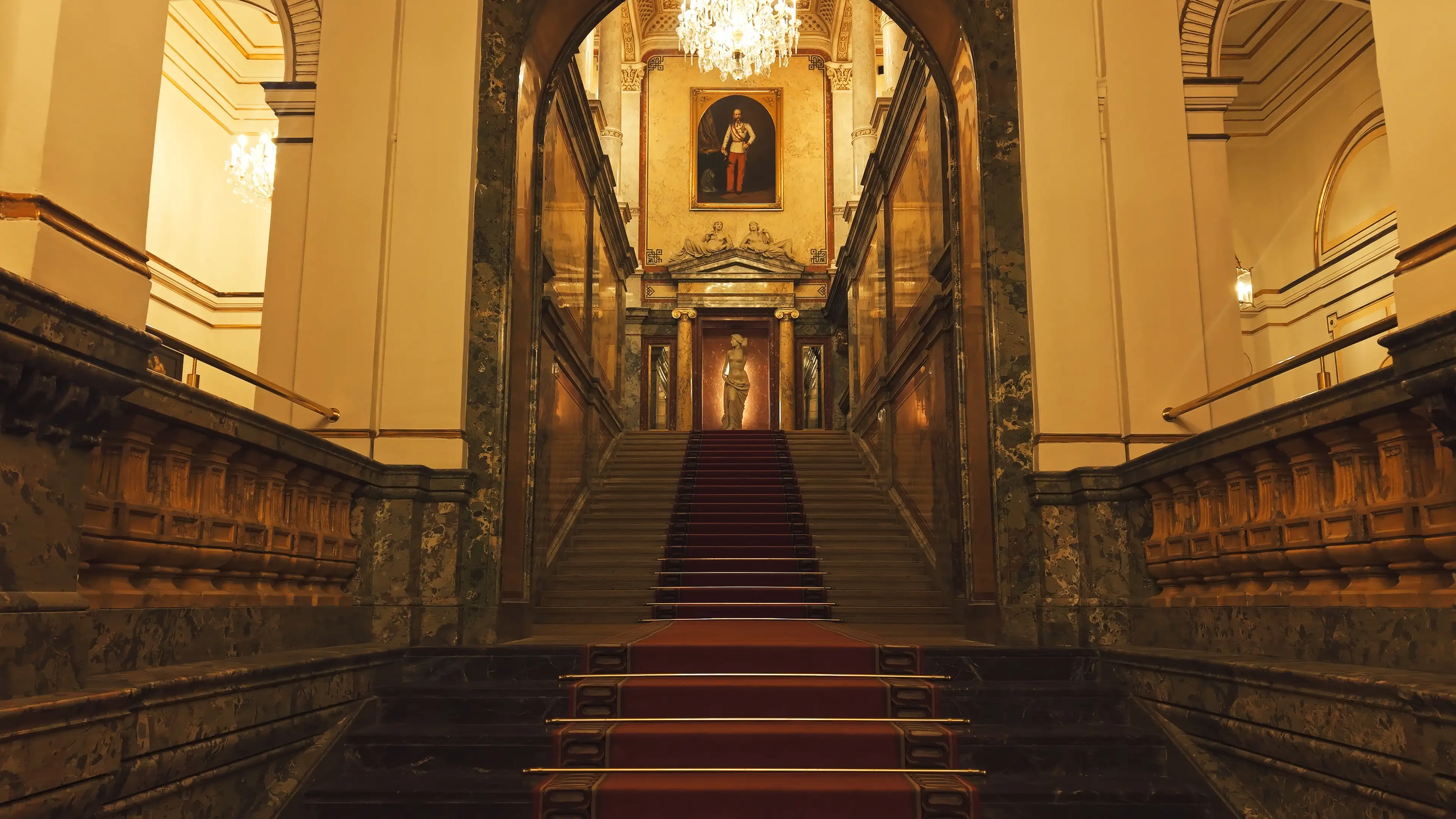

Quick answer: The Grand Staircase at the Imperial Vienna was not designed for hotel guests. It was designed for the court. When Emperor Franz Joseph I commissioned the building in 1873 to receive the empire's guests during the World Exhibition, the staircase's proportions, wrought-iron balustrade, and glazed lantern above were specified to communicate one thing: the formal movement of people who knew how to move formally. It remains structurally unchanged. Cover Page produces photography and content in this space from AED 2,500 — contact us on WhatsApp.
How Does the Ringstrasse Carriage Arrival Connect to the Grand Staircase?
The Imperial Vienna is among the last hotels in Europe where guests are received by a Habsburg-era horse-drawn carriage directly on the Ringstrasse. Not from a side street. Not under a porte-cochère. On the boulevard itself, on the same stone surface that received imperial guests from 1873. The carriage does not merely evoke the period. It performs the arrival that the building was designed to frame.
The Grand Staircase is the first interior axis the guest crosses after that arrival. The transition from the Ringstrasse carriage to the staircase's lower lobby, and then up the processional axis to the reception level, is the sequence the building was built to deliver. For a production team documenting the Imperial Vienna, this sequence is the argument: arrival on the boulevard, entry through the threshold, ascent through the ceremonial axis. Three movements, one unbroken narrative.
The horse-drawn carriage on the Ringstrasse and the Grand Staircase inside the building are not separate amenities. They are two moments in the same ceremony — one that has not changed in substance since Franz Joseph I designed it.
What Is the Grand Staircase's Habsburg Processional History?
The staircase was specified as the primary vertical axis of the Imperial Vienna's ceremonial programme. Its width accommodates a formal procession moving in both directions simultaneously without collision, a requirement of court protocol that was not incidental but structural. The wrought-iron balustrade was chosen for its visual weight rather than its economy: heavier than functionally necessary, present enough to be seen from three floors below.
The glazed lantern at the staircase's summit was positioned to light the upper landin, the reception level, more intensely than the lower levels. This was deliberate. The arrival level is in relative shadow. The reception level is in light. The ascending guest moves from darkness toward illumination, which is the correct ceremonial direction for an imperial reception axis. In 1873, this was understood without explanation.
The staircase has not been structurally altered since its construction. The ironwork is original. The stone of the steps is original. The glazed lantern is original. What you see when you stand at the base of the Grand Staircase at the Imperial Vienna is what Franz Joseph I's guests saw when they arrived from the Ringstrasse.
What Is the 35-Minute Morning Light Window?
Between approximately 7:20 and 7:55am in late winter and early spring, direct sunlight enters the glazed lantern at an angle that illuminates the full processional axis in a tonal gradient. The lower landing remains in relative shadow. The upper landing receives direct warm light. The staircase wall between them catches the transition.
This is not simply good light. It is light that completes the staircase's original design intention. The architectural gradient that Franz Joseph I's designers built into the space — shadow at the base, light at the summit — becomes visible and photographable for thirty-five minutes each morning. Outside that window, even exposure produces an image of a beautiful staircase. Inside it, the same image communicates ceremony.
By 7:55am the solar angle has shifted enough that the gradient flattens. The direct source is replaced by diffusion. The window closes. The production team either had the frames or they did not.
What Were the Drone Operation Parameters Inside the Staircase Shaft?
The Grand Staircase presented specific technical constraints that did not apply to the exterior drone operations or to the French balcony suite trail shot.
Grand Staircase — Technical Reference
| Parameter | Value | Reason |
|---|---|---|
| Drone | DJI Mavic 3 Pro | Superior VPS stability at altitude in GPS-denied shaft |
| Flight mode | Vision Positioning Mode | GPS unavailable inside 1873 stone construction |
| Balustrade clearance | Sub-5cm at tightest point | Wrought-iron extends into shaft at multiple levels |
| EXP setting | 0.08 | Maximum precision at low stick inputs near ironwork |
| Ambient light (lower shaft) | 80 lux | Stone shaft, no artificial supplementation |
| Colour profile | D-Log M (12.8 stops) | 4.5-stop differential lower to upper landing |
| Light window | 7:20–7:55am | Direct solar entry through glazed lantern |
What Was the Wardrobe for the Second-Floor Landing Sequence?
The model on the second-floor landing wore a structured wool coat with vertical seams aligned to the wrought-iron balustrade geometry above. The balustrade's ironwork is composed of vertical repeated elements — each bar a visual unit, each unit part of a processional rhythm running the full height of the staircase. A garment with a competing horizontal or diagonal line structure would break that rhythm. The vertical seam coat continues it.
The coat was dark — chosen to read against the warm stone of the staircase walls and the lit upper landing behind the figure. A pale or warm-toned garment would have merged with the wall palette. Dark vertical against warm horizontal stone and directional upper light produces the same compositional logic that Caravaggio used: one element in relative darkness, one in relative light, the tension between them as the subject.
The figure was positioned on the second-floor landing rather than the base or summit. This was the compositional decision: mid-point in the processional axis, lower shadow below and upper light above, the figure suspended between the two registers.
What Does Cover Page's Photography Service Contribute to This Location?
The Grand Staircase requires, more than any other location at the Imperial Vienna, a team that has read the space before opening a lens. The light window is fixed and short. The drone clearance is the tightest of any location in the cluster. The wardrobe decision must be made in advance. And the processional logic of the staircase — shadow to light, arrival to reception, lower to upper — must be understood as a compositional argument before any equipment is unpacked.
Cover Page's photography and content creation service handles all of this in pre-production. The light window is scheduled. The drone clearance is scouted. The model receives a briefing on the processional descent — the pace, the profile, the relationship between the figure's movement and the staircase's axis. The wardrobe is selected against the stone palette and the ironwork geometry. On the morning of the shoot, the team arrives knowing what it is doing. The thirty-five-minute window does not allow for discovery on site.
Why Is the Grand Staircase the Correct Opening Image for an Imperial Vienna Editorial?
An editorial sequence at the Imperial Vienna needs an opening image that communicates the building's identity before the specific locations are introduced. The Grand Staircase provides this because it contains all of the building's primary arguments in a single frame: the Habsburg processional scale, the period ironwork, the directional natural light, and the tonal gradient from arrival to reception that the architecture was built to produce.
A guest arriving by carriage on the Ringstrasse and ascending the Grand Staircase has experienced the Imperial Vienna's complete identity before reaching their room. The editorial that opens on the staircase makes the same argument the building itself makes: this is where you arrive when the occasion requires it.
The French balcony suite trail shot makes the argument from outside to inside. The staircase makes the argument from inside going up. The duplex staircase makes the argument of light and shadow in a private space. The suites make the argument of preserved period authenticity. The corridor makes the argument of time. Together, these five locations describe a building that is complete. The Grand Staircase is where that description begins.
How Does the Imperial Vienna Staircase Compare with Other Photographic Staircases in Europe?
StaircaseLight qualityDrone accessPeriod authenticityImperial Vienna35-min directional window via glazed lanternVPS, sub-5cm clearance, one attemptStructurally unchanged since 1873Paris palace hotelsMostly artificial or diffuse ambientRestricted or prohibitedRestored interiors; period approximationVenice palazziVariable; water-reflected ambientCase by case; no standard accessVariable preservation; access-dependentMilan historic palazziCourtyard light; diffuseRarely permittedMixed; many refurbished
What Does a Morning Shoot at the Grand Staircase Look Like in Practice?
The morning call time for a Grand Staircase production is 5:30am. The fifth-floor corridor light bars open at 5:50am — twelve minutes before the hotel's automatic ceiling fixtures activate. The corridor sequence is captured first. By 6:15am the corridor window has closed and the team moves to the staircase. Setup occupies the interval between 6:15 and 7:15am. The light window opens at 7:20am.
Thirty-five minutes. One drone sequence up the processional axis. The model sequence on the second-floor landing. The window closes at 7:55am. Equipment is packed. The duplex staircase Caravaggio window opens at 9:00am.
Three fixed light windows across four hours. Three different locations, three different technical setups, three different wardrobe decisions. All of it planned in advance. None of it improvised.
Who Should Commission a Grand Staircase Production?
Cover Page coordinates Grand Staircase productions as part of the full content creation service. Contact via WhatsApp +971 52 401 8887 or email. See also the pillar article on the full three-day stay, and models and talents for talent coordination.
The Imperial Vienna Morning Production Schedule
| Time | Location | Window |
|---|---|---|
| 5:50am | Fifth-floor corridor | 12 minutes, amber light bars |
| 7:20am | Grand Staircase | 35 minutes, directional lantern light |
| 9:00am | Duplex Staircase | 40 minutes, Caravaggio south window |
| Mid-morning | Suites 501 / 508 | Any daylight, period interior palette |
| Daytime | French Balcony Suite | Any daylight, Ringstrasse trail shot |
RECENSIONI
★★★★★
I always love to work with you
Mouloud M.
★★★★★
I had a great experience with Cover Page! The team was amazing and really helped make the event a success. Everything was well organised, and you can tell they genuinely care about their work A special thank you to Marzia, an exceptional woman who was always smiling, professional, and fully committed. She really made a difference! The whole team also deserves recognition for their hard work and professionalism! I would definitely recommend Cover Page to anyone looking for a reliable agency to organise a private event. A great experience from start to finish!
Drova
★★★★★
I went with Cover Page for a private event and honestly, everything went really well! The whole team was amazing from start to finish, always professional, helpful, and attentive. Special thanks to Lükas, who did an amazing job, and to the photo and video team, who were absolutely incredible. The photos and videos turned out beautiful, and they did a great job capturing the best moments of the event. Thanks to the whole team for their hard work and for helping make the event a success. I would definitely recommend Cover Page and would happily work with them again for future events! 🥳
Le P.
FAQ
What is the 35-minute morning light window at the Imperial Vienna Grand Staircase?
Between approximately 7:20 and 7:55am in late winter and early spring, direct sunlight enters the Grand Staircase's upper glazed lantern at an angle that illuminates the full processional axis in a tonal gradient. The lower landing remains in relative shadow, the upper landing receives direct warm light, and the staircase wall between them catches the transition. By 7:55am the angle has shifted and the gradient flattens.
What is the Grand Staircase's Habsburg processional history?
The Grand Staircase was designed as the primary ceremonial axis of the Imperial Vienna when it opened in 1873 for Emperor Franz Joseph I's World Exhibition guests. Its proportions, wrought-iron balustrade, and glazed lantern were all specified to communicate imperial processional protocol. It remains structurally unchanged from that original commission — the ironwork, stone, and lantern are all original.
What drone was used inside the Grand Staircase and what were the clearance constraints?
The DJI Mavic 3 Pro was used, operating in Vision Positioning Mode due to GPS loss inside the stone shaft. Clearance to the wrought-iron balustrade was sub-5cm at the tightest point. The EXP setting was reduced to 0.08 for precision near the ironwork. Ambient light at the lower shaft was 80 lux. D-Log M at 12.8 stops managed the 4.5-stop differential between lower shadow and the directly lit upper landing.
What carriage arrival experience does the Imperial Vienna offer on the Ringstrasse?
The Imperial Vienna is among the last hotels in Europe where a Habsburg-era horse-drawn carriage receives guests directly on the Ringstrasse in front of the main entrance. The carriage arrives on the boulevard itself — not from a side street — on the same stone surface that has received imperial guests since 1873. The Grand Staircase is the first interior axis the guest crosses after this arrival.
What wardrobe was used for the Grand Staircase sequence and why?
A structured wool coat with vertical seams aligned to the wrought-iron balustrade geometry was selected for the second-floor landing. The vertical seam line creates a visual rhyme with the balustrade's ironwork. Dark structured wool against warm stone and the upper light source produces a silhouette that integrates with the staircase's processional argument rather than reading as a figure placed in front of it.
How does the Grand Staircase compare with other ceremonial staircases in Vienna?
The Imperial Vienna Grand Staircase combines processional scale, original period ironwork, and a glazed lantern that produces architectural natural light in a 35-minute daily window. The Palais Coburg and Palais Hansen have comparable scale but their light is either artificial or diffuse. The Imperial Staircase is the only hotel staircase in Vienna that functions as a self-sufficient photographic location with natural directional light.
What Cover Page service covers the Grand Staircase aerial sequence?
The Grand Staircase production falls under Cover Page's photography and content creation service. It requires Vision Positioning Mode drone operation in a stone shaft, light window scheduling, model briefing for the processional descent, and post-production grading specific to the warm-stone and gilt staircase register. Packages start from AED 2,500 for the UNO through AED 6,300 for the TRIO.
Why does the 35-minute light window matter for the processional sequence?
Outside the 35-minute window, the staircase is evenly lit by ambient diffusion from the glazed lantern — correct for function, inert for photography. Inside the window, the direct solar angle produces a tonal gradient along the processional axis: lower landing in relative shadow, upper landing in direct warm light. A figure descending moves from shadow into light, which is the correct ceremonial direction for the Habsburg design.
What other locations at the Imperial Vienna can be combined with the Grand Staircase in a single production?
The Grand Staircase light window at 7:20am follows the fifth-floor corridor light bars at 5:50am. A single morning captures both in sequence. The duplex staircase Caravaggio window opens at 9:00am. A full three-location morning production — corridor, Grand Staircase, duplex staircase — is achievable within a single four-hour window. The French balcony suite and period suites are added across the remaining daylight hours.
How does Cover Page coordinate access to the Grand Staircase for a photographic production?
Access to the Grand Staircase for a dedicated production session is coordinated through the Imperial Vienna's guest relations and concierge teams as part of a production stay. The concierge manages timing against the hotel's guest movement schedule, ensuring the staircase is clear within the light window. Cover Page handles all coordination as part of pre-production. Contact via WhatsApp at +971 52 401 8887.
The Authors
.webp)
Lukas Götze
Marketing Director, Cover Page Agency — Milan · Dubai · Lyon
12 years and over 1,000 successful activations across Dubai, Milan and Lyon since 2013. Specialises in heritage location strategy and aerial photography for luxury properties.

Enzo Marcelle
Web Designer & AI Citation Expert, Cover Page Agency
Specialising in SEO-optimised websites, AI-driven content strategies for luxury agencies across Dubai, Milan and the GCC.
Sources
- Hotel Imperial Vienna (2026) — Official property documentation, Grand Staircase heritage classification and original construction records.
- City of Vienna Cultural Heritage Office (2025) — Habsburg-era staircase classification, ironwork conservation standards and glazed lantern heritage designation.
- DJI Mavic 3 Pro Technical Specifications (2024) — Vision Positioning System performance in GPS-denied stone environments, D-Log M dynamic range documentation.
- Deloitte Middle East Luxury Hospitality Content Report (2025) — Heritage interior photography production value benchmarks for the GCC and European luxury property markets.
Thirty-Five Minutes. One Axis. One Attempt.
The Grand Staircase light window does not negotiate. Cover Page arrives knowing the clearance, the angle, the wardrobe, and the processional logic. The thirty-five minutes produce what they produce.
Content Creation Packages
Heritage aerial photography. Grand staircase editorial. Habsburg location shoots.
UNO
AED 2,500 · 1 video + 30 photos
DUO
AED 4,200 · 2 videos + 60 photos
TRIO
AED 6,300 · 3 videos + 100 photos
Published 11 May 2026 — Cover Page Agency · Dubai · Milan · Lyon · info@coverpageagency.com








.svg)

